[Ep. 1] Chang Sunwon
On April 18th, 2026, artist Chang Sunwon (Seoul, 1998) welcomed us into her current working studio at Seoul National University. About to graduate from her MFA and with a lot of ongoing projects in sight, she sat down to tell us about her process, her inspirations, and her goals.
ABOUT THE NARRATIVES BEHIND
When you’re about to begin a new work, how does the natural flow of ideas become a clear decision?
There are some references, but mostly I write texts or imagine things in the form of video. When I start working on something specific, I begin by writing and imagining things beyond the basic structure. I think the process mostly unfolds in a natural way.
You often work with mythology and traditional stories. When you begin a work, do you tend to follow the original narrative, or do you construct a new one from it?
I construct a new one. My main aim is to twist the basic narrative of traditional mythology and find something more bodily.
For example, I focus on elements like the body of a woman, or parts of non-human beings, like horns or tentacles; things that are not central in traditional narratives, but still carry a strong energy.
So I’m not really following the original story. In my paintings, there aren’t many direct references either. I mainly use the “grammar” of mythology, its structure, rather than specific stories.
You mentioned that you use the “grammar” of mythology rather than the original story. When forms change in your work, is that intentional or does it happen gradually?
It happens gradually. In sketches, the body is clearer and more structured. But as I paint, it slowly changes and becomes less readable. That transformation is a very important part of my process.
Since you’re not following a fixed narrative, but rather reworking its structure, I’m also curious about how you think about the way myths themselves are transmitted over time.
When you look at how myths are transmitted, they often don’t have a clear origin and are shaped collectively. They are imagined narratives created with certain purposes.
Because of that, I think they hold a lot of potential for transformation. But at the same time, the way they are passed down can be quite rough or simplified.
I try to dig into that and reimagine what might be missing — especially bodily sensations or physical aspects that are not clearly described. I want to bring those back and expand them into something more material, more raw, and more wild.
ABOUT MATERIALS AND PROCESS
In some of your works, there seems to be a layering of images — like paper placed on top of another surface, or images stacked on top of each other. It creates a sense of depth or accumulation. How do you think about that?
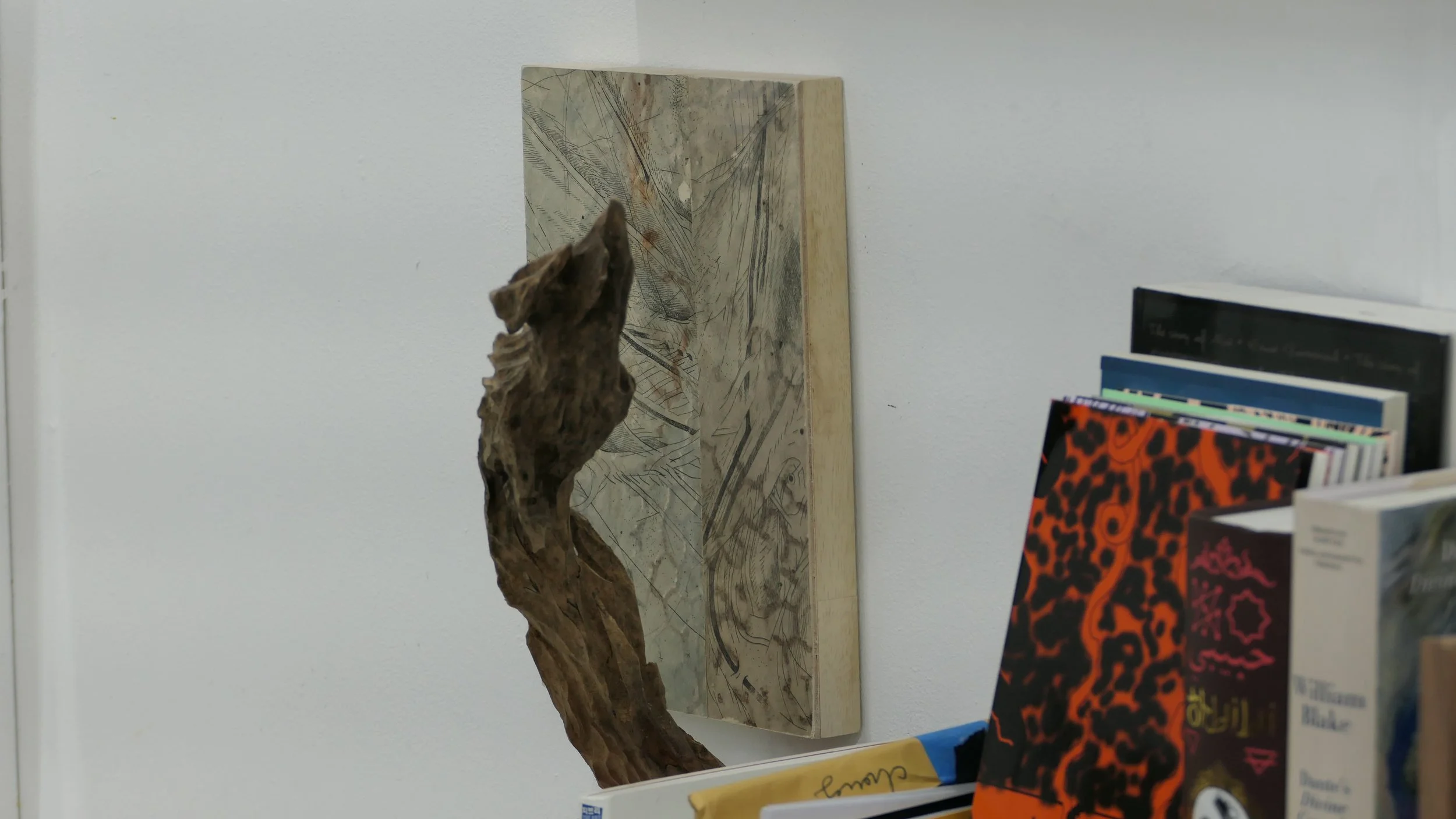
In some works, there is a layer of paper placed on top of the image, and in others, additional images are added on top, creating a sense of multiple layers.
This kind of layering is connected to how I think about images — how we perceive them and how meaning is constructed. Basically, I try to create a world and immerse myself in it, but at the same time, I am also constantly stepping out of it.
So even when I create a scene or a narrative, I don’t want it to feel completely closed. I want to show that it’s still open, still shifting. That’s why I use methods like layering paper, creating frames, or placing images on top of other images. Through this, the work can feel not only like a flat surface but also like a screen - something that is constantly being perceived as an image.
Sometimes unexpected elements appear, or different forms connect with each other in unpredictable ways. I think those relationships are an important part of the work.
When I first saw your work, that layering felt almost like multiple temporalities or historical traces were embedded in it. It felt like something that contains time.
Yes, I think there is a sense of time embedded in the image. It can feel historical or aged, but also very present at the same time.
Do you see your works more as images or as objects?
Both. The imagery is imaginary and non-realistic, but I want it to exist on the surface of reality and not get lost in illusion. So I think of it as both image and object.
In your exhibition, there seemed to be two different approaches: drawings that felt more monstrous, and paintings that appeared more human, though still abstract. How do you see this difference?
Actually, oil painting has always been my main medium. I started drawing because oil paint feels very slippery. Drawing allowed me to explore forms differently, but painting is still my primary practice.
You use traditional materials like hanji and ink. How does that influence your work?
I’ve used hanji since I was very young. It has fibers, so you can build layers by erasing and drawing repeatedly. It feels natural to me. I’m also influenced by traditional East Asian painting, such as Japanese emaki scrolls.
ABOUT SPACE
Your works feel like fragments of a larger story. How do individual pieces relate to each other and to the exhibition space?
Each work is fragmentary, but they are connected within the overall space and series. Even if the details differ, they share a broader structure.
And when you exhibit, do you think about how the work relates to space? For example, how it expands beyond the canvas?
When it comes to exhibitions, I think it’s important that the work is experienced not just as a single image, but in relation to the entire space. Sometimes the work feels like it expands beyond the canvas and into the surrounding environment.
Have you had experiences where the space itself really changed how the work functioned?
Yes. In a previous exhibition, the space itself played a very important role. It wasn’t a white cube, but a converted building, and the work responded directly to that environment. That made the exhibition particularly meaningful.
So the relationship between the work and the space doesn’t always have to be direct, but it can still expand into it?
Even when the work is not directly connected to a specific space, I think it can still naturally occupy or expand into it.
Almost like the work can either absorb the space or extend out of it?
Yes, exactly. That relationship is something I’m always thinking about.
ABOUT THE INTERACTIONS WITH AN AUDIENCE
What about when the work is finally experienced by viewers within that space; do you hope they understand or feel?
I hope they speculate about what they are looking at. Maybe they recognize something, or maybe they don’t. That’s fine. They don’t have to understand it. What I want is for them to feel something from the work.
One thing I really like about your work is your use of titles. Your titles are very specific, but they don’t necessarily explain the image — like Without a Hurry, for example. The painting feels quite unsettling, almost monstrous, so the title doesn’t tell the viewer what to see, but it creates a connection with you as an artist.
I can't leave artworks untitled. Making titles is very important in my process. It’s the only clearly recognizable element in the artwork, but I don’t want to explain everything. The title works like a clue.
If you could present your work in another cultural context, where would you like to go?
Recently I’ve been interested in Germany — I don’t know why. Also, I did an artist residency in Japan two years ago. I worked on a project related to a shrine there. There was a tree that was about 2,000 years old, considered sacred, and connected to local folklore and mythology.
Do you feel like your work changes depending on the place?
Yes, definitely. I’m interested in local elements and small stories tied to specific places.
If you were to work in Germany, how do you think that would affect your work?
I would study the history and cultural context. That’s always important for me.
Is there anything you’d like to share about your current work?
Right now I’m trying new things. I feel like I’m in a period of change.
© Artist studio, 2026. Courtesy of the artist, Chang Sunwon
